What is the smallest act of kindness you can imagine? Perhaps it is holding someone’s hand. Perhaps it is sitting beside a person who is alone.
Perhaps it is looking into the eyes of a stranger and simply saying, “I see you. You matter.” These are small things.
 They cost nothing. They require no money, no education, and no special talent. And yet, one woman spent her entire life doing nothing more than these small things.
In doing so, she became one of the most famous people on the planet.
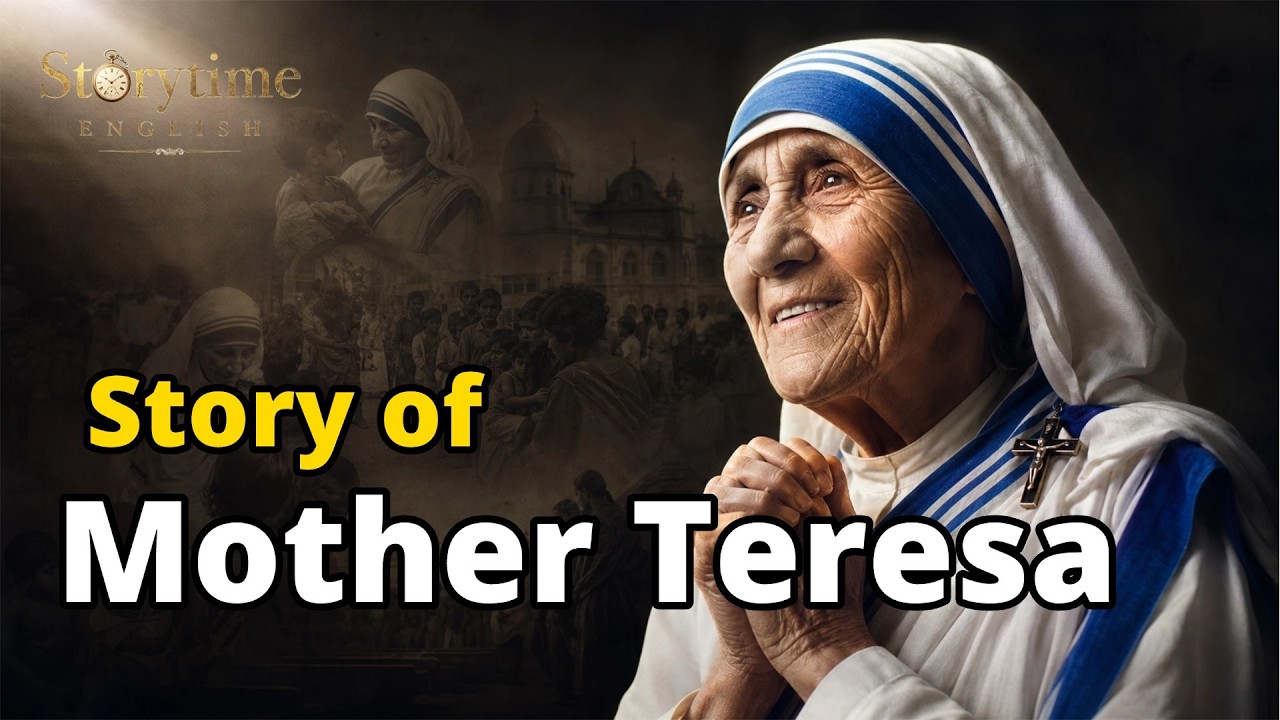
The name the world knows is Mother Teresa. But that is not the name she was born with. The story of how a girl from a quiet town in the mountains became a symbol of compassion for the entire world is stranger and more complicated than most people realize.
It is a story about leaving everything behind, about walking into the darkest places, and about continuing to work even when the light inside goes out.
She was born Agnes Gonxha Bojaxhiu on the 26th of August, 1910, in the city of Skopje. At the time, it was a small dusty town in the Ottoman Empire. Today, it is the capital of North Macedonia.
Her family was Albanian. They were devout Catholics in a region where most people were Muslim or Orthodox Christian. This made them a minority, a small community of faith within a larger, more complex world.
Her father, Nikola, was a successful merchant. He was also a generous man who often brought strangers home for dinner. He taught his children a simple rule for life.
“Never eat a single mouthful,” he told them, “unless you are sharing it with others.” This idea of sharing, of making room for the stranger, was planted in Agnes very early. It became the foundation of everything she would later build.
When Agnes was only eight years old, her father died suddenly. Some historians believe he was poisoned. He was involved in local politics, and the times were dangerous.
His death devastated the family. Her mother, Dranafile, was left alone with three children and almost no income. The security of their life vanished overnight.
But Dranafile did not collapse. She began sewing and selling cloth to support her family.
She continued her husband’s tradition of generosity. She fed the poor. She visited the sick.
She cared for anyone in the neighborhood who needed help. Agnes watched her mother closely. She saw a woman who had lost everything and responded not by closing her door, but by opening it wider.
This lesson was more powerful than any sermon. It taught Agnes that generosity is not about having extra. It is a choice you make even when you have nothing.
By the time she was 12, Agnes began to feel something pulling at her from inside. It was a quiet, persistent voice telling her that her life belonged to God and to the service of others. At 18, she made a decision that most people would find impossible.
She left her family. She left Skopje. She left her country.
She would never see her mother again. This was her first great act of sacrifice. She traveled first to Ireland, to a convent of the Sisters of Loreto in Dublin.
She learned English there, the language she would need for her work in India. She had never been so far from home. She spoke very little English when she arrived.
She was a stranger in a cold, gray country, far from the warm mountains of her childhood. She studied hard, praying between lessons, counting the days until she could begin her real mission. After just a few weeks, she was sent to the other side of the world.
She arrived in Calcutta in January 1929. She was a teenager from a small Balkan town, stepping into a world that was unlike anything she had ever seen. The heat was overwhelming.
The noise was constant. The colors were bright and chaotic. The smell of spices, smoke, and river water filled the air.
Everything was new and 𝓈𝒽𝓸𝒸𝓀𝒾𝓃𝑔. She spent her first two years as a novice in the hill town of Darjeeling, learning the ways of the Loretto order.
She took her first vows and chose the name Teresa. She chose it after Saint Therese of Lisieux, the French saint known for doing small things with great love. This was a significant choice.
She was not aiming for grand gestures. She was committing herself to the small, invisible acts of care that most people overlook. Then she was sent to Calcutta to teach.
For nearly 20 years, Sister Teresa taught geography and history at a convent school for girls.
She was a good teacher. She was well-liked. She rose to become the headmistress of the school.
By all outward appearances, she had found her place. She had a meaningful career within a safe community. But the convent was surrounded by a wall.
 And on the other side of that wall was a world of unimaginable suffering. Calcutta in the 1940s was one of the poorest cities on Earth. The streets were filled with people living in desperate poverty.
Families slept on sidewalks. Children begged for food. Sick and dying men and women lay in gutters with no one to care for them.
The Great Bengal famine of 1943 killed millions of people. People crawled to the gates of the convent begging for food. Sister Teresa could hear them through the walls.
She could hear their voices, their cries, their silence. The wall that protected her also imprisoned her. She knew she could not stay behind it forever.
On the 10th of September, 1946, Sister Teresa boarded a train from Calcutta to Darjeeling. She was going on a spiritual retreat. Somewhere on that long, slow train journey, something happened.
She would later describe it as the call within the call. She felt, with absolute certainty, that God was asking her to leave the convent. She was to leave the safety, the routine, and the comfortable walls.
She was to go out into the streets of Calcutta to serve the poorest of the poor.
Not from behind a wall. Not through a window. But face-to-face, hand-to-hand, in the dirt and the darkness.
It took two years to receive permission from the church. Leaving a religious order is not simple. It required approval from Rome itself.
In 1948, Sister Teresa walked out of the convent for the last time. She exchanged her black religious habit for a simple white cotton sari with blue stripes. It was the cheapest cloth available, the kind worn by the poorest Indian women.
She had no money. She had no organization. She had no plan beyond a single intention.
She intended to find the people who had been forgotten and to be present with them. She went first into the slums of Moti Jheel. It was one of the poorest neighborhoods in Calcutta.
Families lived in tiny shelters made of cardboard and scraps of metal. The narrow lanes smelled of sewage and cooking fires. Children ran barefoot through puddles of dirty water.
She found children sitting in the mud and began teaching them the alphabet. She wrote letters in the dirt with a stick. She had no classroom.
She had no blackboard. She had no books. She had a stick and the ground.
Those first weeks were the hardest of her life. She wrote in her diary that the temptation to go back to the convent was overwhelming. Inside the convent, she had a bed, three meals a day, and the company of other nuns.
Now she had nothing. She begged for food. She slept wherever she could find shelter.
She had no income and no supporters. She was a 40-year-old European woman alone in the most desperate streets of an Indian city. No one had asked her to come.
She had asked herself. But she kept going. Within days, other volunteers began to appear.
They were former students from her convent school who had heard what she was doing and wanted to help. The school in the dirt grew.
But it was the dying who called to her most powerfully. In the streets of Calcutta, people died alone every day. They died on sidewalks, in alleyways, and in the gutters beside busy roads.
They died of tuberculosis, cholera, leprosy, and starvation. Hospitals would not take them. They were too poor, too sick, too far gone.
They died without anyone knowing their names. They died without anyone touching them. They died without anyone telling them that their lives had mattered.
In 1952, Mother Teresa opened a home for the dying. She had founded a new religious order, the Missionaries of Charity, two years earlier. She was now called Mother by her growing community of sisters.
She called the home Nirmal Hriday, which means Pure Heart in Bengali. The Calcutta city government gave her a building beside a Hindu temple. It was a simple place.
It had rows of low cots, clean sheets, and nothing else.
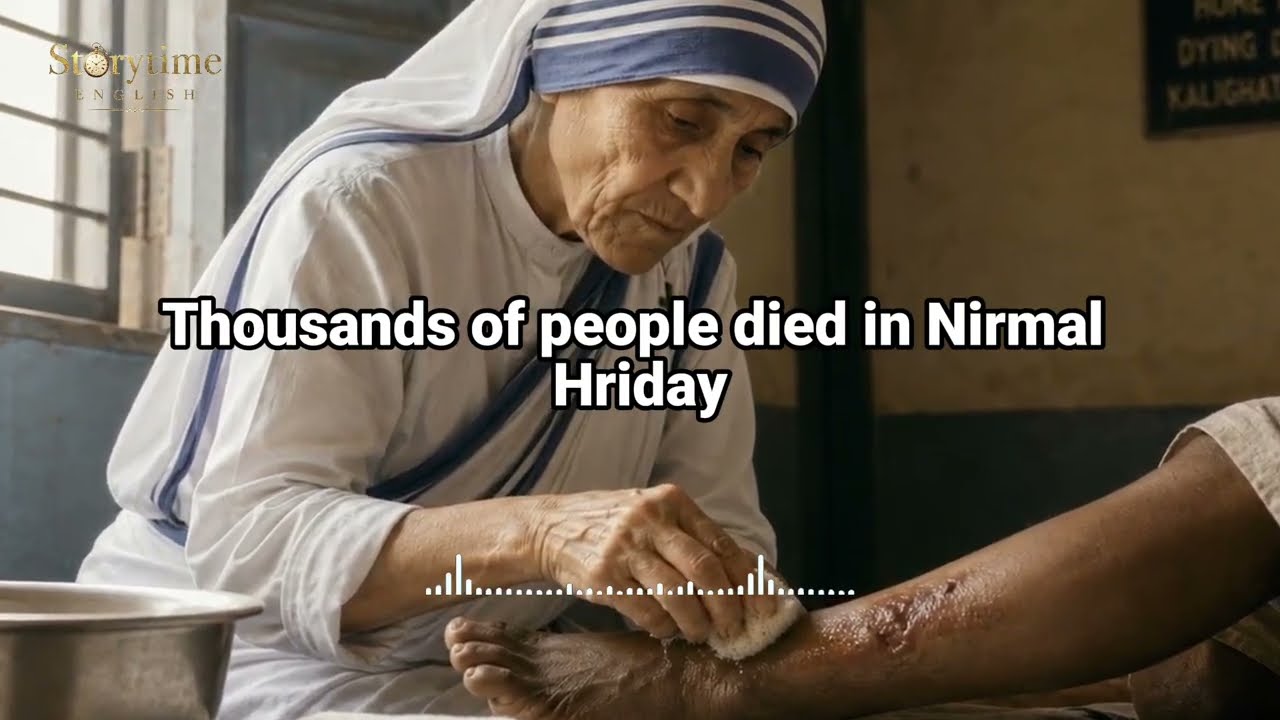 The idea was not to cure these people. Many of them were beyond any medical help. The idea was simpler and in some ways more radical.
The idea was that no human being should die alone and unloved. The sisters would go into the streets and find men and women who were dying in the gutters. They would carry them to the home.
They would wash them. They would feed them. They would hold their hands.
They would stay with them until the end.
A Muslim would be read verses from the Quran. A Hindu would be given water from the Ganges. A Christian would receive last rites.
Every person would die with dignity. They would die in the faith they were born with. They would die knowing that someone cared.
Not everyone welcomed her work. Some Hindu nationalists accused her of trying to convert dying people to Christianity. Some doctors criticized the home for providing comfort instead of proper medical treatment.
Mother Teresa did not argue. She simply said, “We are not here to be successful. We are here to be faithful.”
She opened more homes. She opened centers for people with leprosy, a disease that causes terrible damage to the skin and nerves. The disease made people so feared and rejected that they were often thrown out of their families and forced to live alone.
She washed their wounds with her own hands. She touched faces that no one else would go near.
Thousands of people died in Nirmal Hriday over the following decades. And thousands of people died knowing for the first time in their lives that they were not invisible. The Missionaries of Charity grew.
From one convent in Calcutta, the order spread across India. Then it spread across the world. By the time of Mother Teresa’s death, there were more than 4,000 sisters working in over 130 countries.
They ran orphanages, homes for the dying, clinics for people with leprosy and AIDS, soup kitchens, and schools.
The tiny woman in the white sari had built a global network of compassion. In 1979, Mother Teresa was awarded the Nobel Peace Prize. When the committee informed her that a formal banquet would be held in her honor, she asked them to cancel it.
She asked them to give the money to the poor instead. The committee agreed. The banquet was canceled and the funds were donated.
At the ceremony in Oslo, she did not give a political speech.
She spoke about love. She spoke about the unborn. She spoke about the loneliness she saw not only in Calcutta, but in the wealthy cities of Europe and America.
“The greatest disease in the West,” she said, “is not tuberculosis or leprosy. It is being unwanted, unloved, and uncared for.” She became, in her later years, perhaps the most recognized face on the planet.
She was a tiny, bent woman, barely five feet tall. Her face was deeply lined. Her hands were rough and worn from decades of washing wounds and holding the dying.
She met presidents and popes. She met Princess Diana, who held her hands and called her an inspiration. She received the Medal of Freedom from the United States.
She was on the cover of Time magazine. Journalists followed her through the slums of Calcutta. Cameras flashed.
Microphones reached toward her. She would look at them calmly and say, “Do not look at me. Look at the poor.”
Her health began to fail. She suffered a severe heart attack in 1983 and another in 1989. She fell and broke her collarbone.
She developed malaria. Her body was worn out by decades of work in extreme conditions. The heat, the disease, the relentless schedule took their toll.
She tried to resign as the head of the Missionaries of Charity, but the sisters voted to keep her. She continued working until the very end.
But there is one more part of this story. The world did not learn it until after Mother Teresa died. It is, perhaps, the most extraordinary part of all.
 After her death on the 5th of September, 1997, her private letters were collected and published. The world expected to read the words of a saint who lived in constant communion with God. They expected a woman filled with light and certainty and divine love.
What they found was the opposite.
For nearly 50 years, from 1948 until her death, Mother Teresa experienced what she called the darkness. In letter after letter, she confessed to her spiritual advisers that she felt nothing. There was no presence of God.
No warmth. No consolation. No answer to her prayers.
“Where is my faith?” she wrote. “Even deep down, there is nothing but emptiness and darkness.”
She described herself as a hypocrite, smiling in public while feeling only silence inside.
Theologians have a name for what Mother Teresa experienced. They call it the dark night of the soul. It is a period of spiritual emptiness that some of the greatest Christian mystics have described throughout history.
Saint John of the Cross, a Spanish monk who lived in the 16th century, wrote about it first. But no one in recorded history endured a dark night as long as Mother Teresa’s. It lasted 50 years.
Half a century of silence.
For 50 years, the most famous religious figure in the world went to the streets every morning. She held the dying in her arms. She built a global mission of love.
And all the while, she felt inside that she was completely alone. She did not stop. She did not quit.
She did not announce her doubts to the world. She simply kept going. Day after day.
Year after year. She did the work without the feeling. She showed up without the reward.
Think about that train to Darjeeling. A young nun sitting by a window watching the green hills roll past. She felt something she could not explain.
A call within a call. She answered it. She left everything she knew for the second time in her life.
She walked into the poorest streets in the world with nothing but a sari and an intention. And then the voice went silent. For 50 years she heard nothing.
No confirmation. No comfort. No sign that she had made the right choice.
She worked in the dark.
Your English journey will have its own dark stretches. There will be days when the progress feels invisible. Days when the words refuse to come.
Days when you wonder whether any of it is working. You will wonder whether any of it matters. You will wonder whether anyone hears you at all.
Mother Teresa’s letters answer that question. You do not need to feel the progress to be making it. You do not need to hear the answer to be asking the right question.
You do not need light to keep walking.
Sometimes the deepest faith is simply showing up in the dark. Tell me, what part of this story stayed with you the most? Was it the girl who left home at 18 and never saw her mother again?
Was it the home for the dying where no one died alone? Or was it the private letters that revealed 50 years of silence and darkness behind the world’s most famous smile? I would love to hear your answer.
There are many more stories waiting right here. I will be here when you come back. Until next time, take care of yourself and never stop learning.


