Harlem erupted last night as Lloyd Banks, the lyrical architect of G-Unit, took the stage and ignited a firestorm of speculation that has the hip-hop world buzzing with electric anticipation. In a moment that felt both spontaneous and deeply intentional, the Queens-born rap icon paused his electrifying performance, looked out at the sea of devoted fans, and chanted the group’s legendary name with a force that shook the venue to its core. The crowd, already whipped into a frenzy, responded with a deafening roar, their voices uniting in a chorus that seemed to demand an answer to the question now on everyone’s lips: Is a G-Unit reunion truly imminent?
The video footage, captured by DJY and circulating rapidly across social media platforms, shows Banks feeding off the crowd’s energy at his Harlem show, a performance that was already being hailed as a masterclass in hip-hop artistry. As the beat pounded and lights flashed, Banks raised his hand, and with a knowing smirk, he led the chant, “G-Unit!” The audience didn’t just join in; they owned it, turning the venue into a cathedral of nostalgia and raw, unadulterated passion.
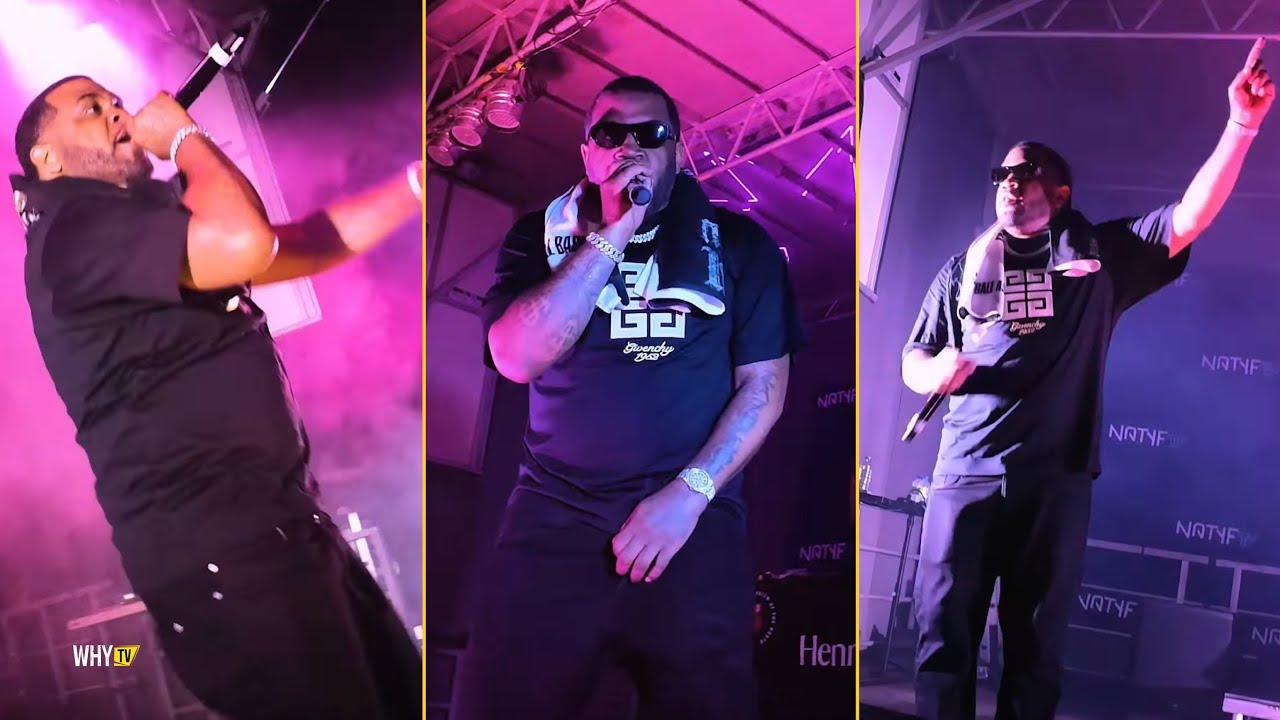 This wasn’t just a performance; it was a declaration, a statement that the legacy of one of rap’s most iconic collectives remains as potent as ever.
For those who have followed G-Unit’s storied history, this moment is laden with significance. Formed in the early 2000s by 50 Cent, Lloyd Banks, and Tony Yayo, the group quickly ascended to become a dominant force in hip-hop, their gritty street anthems and undeniable chemistry defining an era. But like many great dynasties, internal fractures and shifting musical landscapes led to a gradual dissolution, with members pursuing solo careers and leaving fans to wonder if they would ever see the full lineup together again.
Last night’s chant, however, suggests that the embers of that fire have never truly died.
The performance itself was a tour de force, according to eyewitnesses who described the atmosphere as electric from the moment Banks stepped on stage. He ran through a setlist that spanned his entire career, from classic G-Unit tracks to his solo hits, each song met with a level of adoration that silenced any critics who might question his relevance. “He’s still making sold out shows,” DJY emphasized in the accompanying commentary, countering a narrative that some fans have perpetuated on social media, which claims that without 50 Cent, Lloyd Banks’ career is over.
“But I don’t think so,” DJY continued, his voice firm with conviction. “His music is still relevant, and his group G-Unit is one of the greatest hip-hop groups of all time, period.”
Yet, the night’s true headline was the chant itself, a moment that transcended the usual concert crowd participation. It was a collective plea, a shared vision, and a demand for something that fans have been craving for years. Social media exploded almost immediately, with clips of the chant being shared and dissected by millions.
Comments flooded in, ranging from ecstatic support to cautious optimism, but one theme ran constant: the desire for an official reunion. “I want to see an official reunion of G-Unit in 2026,” one fan wrote, echoing a sentiment that has become a rallying cry across forums and comment sections.
The call for reunification is not without its complications. Tony Yayo, another core member and close associate of Banks, has publicly stated that a full reunion may never happen, citing irreconcilable differences and the individual paths that have diverged over the years. But last night, in the heart of Harlem, Banks seemed to challenge that notion.
He didn’t just chant the name; he embodied it, moving through his performance with the confidence of a man whose legacy is secure and whose future is still being written. The crowd responded in kind, their energy a palpable testament to the enduring power of the G-Unit brand.
 The implications of this moment stretch far beyond a single concert. If Lloyd Banks is signaling a desire for a reunion, or even testing the waters to gauge fan interest, it could set off a chain reaction within the industry. 50 Cent, now a global entertainment mogul with television and film ventures, remains the most visible member, but his relationship with his former groupmates has been complex.
In recent interviews, he has focused on his solo and business endeavors, often deflecting questions about a full reunion. But the raw, unfiltered adoration on display last night might be the catalyst needed to bring everyone back to the table.
Lloyd Banks, often referred to as the “Punch Line King” for his intricate wordplay and devastating bars, has never been one to rely on hype alone. His solo discography, including the critically acclaimed “The Hunger for More,” has cemented his status as one of the most skilled rappers of his generation. Yet, he has always acknowledged that G-Unit was his foundation, the platform that launched him into the stratosphere of hip-hop royalty.
By invoking that name last night, he was reaffirming that bond, not just with the group’s history, but with the fans who have remained loyal through every twist and turn.
The concert itself was a masterful blend of old and new, with Banks seamlessly weaving together tracks that spanned his two-decade career. He paid homage to the streets that shaped him, the music that defined him, and the fans who have supported him through it all. There was a palpable sense of gratitude in his performance, a recognition that his journey has been anything but ordinary.
And when he led the chant, it felt like a moment of collective catharsis, a shared acknowledgment that the G-Unit story is far from over.
Industry insiders have already begun speculating about what this could mean for the future of hip-hop. A G-Unit reunion, especially one that includes all original members such as Lloyd Banks, Tony Yayo, and possibly even Young Buck and others, would be a seismic event in the music world. It would tap into a vein of nostalgia that has been particularly potent in recent years, as fans of early 2000s rap seek to recapture the energy and authenticity of that golden era.
Banks’ show last night may have been the spark that ignites that fire.
 The video transcript, though simple in format, captures the essence of the evening with raw, unfiltered energy. “We want fire,” the crowd chants, and Banks delivers, not just through his performance but through his very presence. The fans, many of whom likely grew up listening to G-Unit’s seminal albums, are not just spectators; they are participants in a living history.
They sing every word, they pump their fists, and they chant the name that has come to symbolize resilience, unity, and unapologetic street authenticity.
Social media reactions have been swift and voracious. Platforms like Twitter and Instagram are flooded with comments from fans demanding an official reunion, with many pointing to the palpable chemistry between Banks and his audience as proof that the demand is real. “Please guys make it happen for the love of your fans man,” DJY implored in the video, his voice cracking with emotion.
“We definitely need to see official reunion of G-Unit with all the members, with Banks, with Buck, with Yayo, and of course with 50 Cent and Curtis and Jakes.”
The reference to “Jakes” likely alludes to Jake One, a producer who has worked closely with the group, but the sentiment is clear: fans want the full roster, the original lineup that terrorized radio waves and sold millions of records. They want the grit, the swagger, and the undeniable chemistry that made G-Unit a household name. And if last night is any indication, Lloyd Banks is ready to answer that call.
The significance of the setting cannot be overstated. Harlem, with its rich history of Black culture and artistic innovation, provided the perfect backdrop for this potential rebirth. It is a neighborhood that has seen the rise of countless legends, from the Harlem Renaissance to the golden age of hip-hop.
By choosing to perform there and by leading that chant, Banks was making a statement that extended far beyond music. He was planting a flag, declaring that the spirit of G-Unit is not confined to a studio or a label, but lives in the hearts of the people.
For those who have doubted Banks’ ability to command a stage without the shadow of 50 Cent looming, last night was a definitive rebuttal. He not only sold out the venue, but he also electrified every person in attendance, turning skeptics into believers. The narrative that his career is over without 50 Cent has been a persistent one, fueled by the dramatic ups and downs of the group’s history.
 But Banks, through sheer talent and force of will, has consistently proven that he is a star in his own right. His performance was a masterclass in showmanship, proving that his music remains as relevant and vital as ever.
The chant itself was not a one-off moment; it was a recurring theme throughout the night. Banks wove the call and response into multiple segments of his set, each time met with escalating enthusiasm. The fans, many of whom had traveled from across the region to see him, were more than willing participants.
They saw it for what it was: a potential hint of a new chapter, a signal that the bonds of G-Unit might be stronger than the forces that tore them apart.
In the world of hip-hop, reunions are never simple. They involve complex negotiations, shifting loyalties, and deeply personal histories that cannot be easily resolved. But what was witnessed in Harlem last night was a raw, unscripted moment of pure connection between an artist and his audience.
It was a reminder that music transcends business, that the power of collective memory and shared experience can move mountains. The chant was not just for the group’s name; it was for an era, a feeling, and a legacy that refuses to fade.
The video ends with DJY signing off, but the conversation it has sparked is just beginning. Fans are already calling for tour announcements, album drops, and official statements from the members themselves. The pressure is now on 50 Cent, Tony Yayo, and others to respond.
Will they heed the call? Can the magic of G-Unit be resurrected in a modern music landscape that has changed dramatically since their heyday? These are the questions that will dominate hip-hop discourse in the coming days and weeks.
As the night wore on and the lights dimmed, one thing became abundantly clear: Lloyd Banks is not just a survivor in the game; he is a pillar of it. His performance was a testament to endurance, to the power of staying true to one’s craft, and to the unbreakable bond between artist and fan. The chant for G-Unit was more than a nostalgic nod; it was a declaration that the group’s music still resonates, that its influence is still felt, and that its potential is still untapped.
For now, the world watches and waits. Will this be the moment that leads to an official reunion in 2026? Or will it remain a beautiful, fleeting moment of collective hope?
Either way, Lloyd Banks has done what he does best: he has sparked a conversation, ignited a movement, and reminded everyone why G-Unit remains one of the most celebrated names in hip-hop history. The beat is still pumping, the crowd is still cheering, and the legacy of G-Unit is stronger than ever. The only question is: who will answer the call?


