Vesper had been living in the old elevator’s scale house for three weeks when Marlow finally came out from under the desk. The cat crept into the middle of the room, sat down, and began grooming herself as if the place had always been hers. Vesper took it as a small victory. She had moved in with little more than her coat, her cat, and the name Thistlewood burning in her chest, and she had made it through the first weeks on sheer stubbornness and the kindness of people who asked nothing in return.
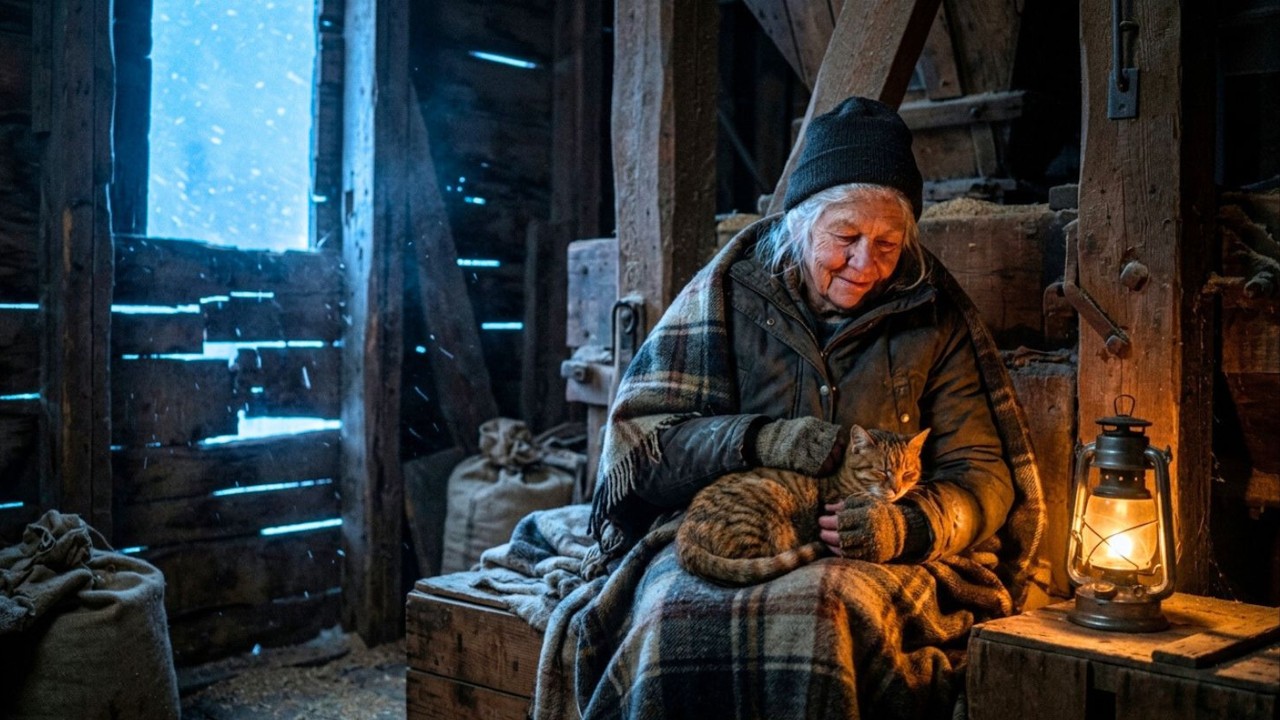
Hazel’s diner on Main Street became her anchor. Ruth Pemberton, the heavy-set waitress, never asked why an elderly woman kept coming in to use the bathroom and nurse a single cup of coffee for hours. She just refilled it without comment. The co-op’s old scale house had no water and no electricity, but Ruth never made her feel small about it.
Small towns have their own ways of taking care of their own, and Vesper began to understand that these kindnesses, the ones that expected nothing, were going to matter more than she’d ever realized. She thought about Callum less than she expected. Not because the anger had faded, but because there wasn’t room for it most days. There was too much else demanding her attention.
The desk that had come with the room became a proper workspace once she sanded down the rust stains and oiled the drawer slides. From the highest platform, she could see across the frozen fields to where the county road disappeared toward the Thistlewood farm. It didn’t do her any good to look at it, but she couldn’t stop herself. The first drawer held nothing but ruined paper, ink long since bled into illegibility by decades of moisture.
But the second drawer held a folder that had survived better than the rest. Newspaper clippings, brittle and yellowed, described a man named Aldous Thistlewood, a name that stopped her cold the first time she read it. The clippings called him the Co-op’s founding secretary, praised him for forty years of service, and spoke of his retirement with nothing but warmth. Vesper had grown up hearing that her grandfather had failed at everything he touched, and yet here, in ink older than she was, was a different story.
She spent the winter reading by lantern light, spreading the yellowed pages across the desk one folder at a time. The records told the story slowly, the way old documents do, revealing themselves in fragments that only made sense once she’d gathered enough of them side by side. And what they told her was this: the Co-op’s collapse had never been an honest failure. It had been the direct result of a man quietly bleeding the organization dry while telling its members, right up until the end, that their reserves were safe.
Prairie Trust Holdings, the records showed, had been established in 1967, four years after the Co-op’s founding. Its founding documents named Aldous Thistlewood as the sole beneficiary. Vesper had to read that part twice, and then a third time, before she set the page down and stared at the lantern flame for a long while. The same year the Co-op failed, its grain elevator and scale house were sold for $850 to that trust, the very trust that was set to carry the Thistlewood family fortune into the next generation.
She didn’t confront anyone right away. Vesper had learned patience the hard way, and she knew that anger alone wouldn’t undo sixty years of careful deception. So she kept reading. The records showed dividends flowing into the trust every single year, rain or drought, up until the very month the Co-op was declared insolvent.
By the time the elevator was sold to Prairie Trust Holdings in 1972, it held over $11,000 in accumulated reserves, more than enough to cover the debts the Co-op defaulted on. Yet the members were told there was nothing left. It took her until March to find the final piece. A single cancelled check, dated March 9, 1972, made out to Aldous Thistlewood from Prairie Trust Holdings, signed by Aldous Thistlewood himself.
The money that should have saved the co-op had gone into her grandfather’s pocket, and the rest had been funneled into the trust that would one day become Callum’s inheritance. Vesper sat with that for a long time before she said anything out loud, even to Marlow curled beside the lantern. Elias Thistlewood had written his will twenty years before Vesper moved in. He had left everything, the farm, the money, the trust, to Callum, and he had never updated it.
Even if he’d known what Vesper would find, he’d had two decades to change it and hadn’t. She couldn’t know if that was old love or old guilt, and she wasn’t sure it mattered anymore. She spent an evening at the county library researching fraud. The law was clear: trusts built on provably fraudulent original assets could be challenged by any party with standing, including descendants of those originally defrauded.
The Co-op had never filed for bankruptcy in a way that would have protected it from this kind of claim. The statute of limitations had long since passed, but the fraudulent conveyance itself left the trust vulnerable to challenge even now, if only someone had the standing and the evidence to do it. She wrote to a lawyer in the county seat, a woman named Priscilla Wren who specialized in agricultural trust disputes. She described her situation in general terms first, without naming names, the way a person tests water before jumping in.
The response, when it came, was cautious but encouraging. Priscilla Wren wrote back that Vesper should gather everything she had and bring it in, and that if the documents showed what Vesper suspected they showed, then yes, it might be possible. Vesper spent the next month building her case the way she’d once built a fence line, one post at a time, checking each for solidity before moving to the next. She copied every ledger, every cancelled check, every letter, every board meeting minute that mentioned Prairie Trust Holdings.
She organized them in chronological order and tabbed the pivotal pages. She was, to quote Priscilla Wren after she reviewed the digital copies, “better documented than most fraud cases she’d seen cross her desk in 20 years of practice. ” The original ink, the co-op letterhead, the internal consistency of names and dates across hundreds of pages, all of it would hold up. Priscilla Wren agreed to take the case on contingency, no fee upfront, only a percentage of whatever she recovered.
Vesper was grateful and didn’t question it. She had seen enough of the trust’s filings to know the family was still wealthy, and she had seen enough of the law to know that when the evidence was this clear, the outcome was rarely in doubt. The first letter to Callum went out certified mail in the middle of April. It was brief and factual, stating that Vesper possessed documentation showing the Thistlewood family trust had been built on funds fraudulently diverted from the Prairie Wind Co-op, and that she intended to file suit to recover those funds for the co-op’s surviving members unless an equitable settlement could be reached.
She gave him thirty days to respond. Callum’s response, when it came, was exactly what she’d expected. He dismissed the claims as the bitter imaginings of a woman who’d wronged his family and been cast out for it. He threatened to sue her for defamation.
He called her a grifter, a gold-digger, and worse. Vesper read the letter twice, folded it neatly, and put it in the file with everything else. Then she called Priscilla Wren and told her to proceed. The lawsuit was filed in early May.
It named the Thistlewood family trust, Prairie Trust Holdings, and Callum as trustee, and it sought damages equal to the co-op’s lost assets, plus interest and legal costs, to be distributed among the co-op’s surviving members and their descendants. The paperwork was thick enough to make a sound when it hit the desk, and Vesper recognized that sound. It was the sound of a reckoning. The months that followed were a test of everything she’d learned.
Depositions, document demands, motions, delays. Callum fought it at every turn, but Vesper had been patient for decades, and she had the evidence. The trust documents showed the direct, traceable line from Prairie Trust Holdings to the Thistlewood family trust, amended and expanded over the years but never fully severed from its origins. The farmhouse and its surrounding acreage, never directly named in the suit, were tied up as collateral once the trust’s other liquid assets proved insufficient to cover the judgment.
It went up for court-ordered sale within the year. The settlement, when it came, was not a victory lap. It was a quiet accounting. The co-op’s surviving members, and the descendants of those who hadn’t survived, received real money, real restitution for losses that had been hidden for sixty years.
The rest went toward legal fees and a fund for the maintenance of the elevator and the scale house, which Vesper had asked to be preserved. By the time autumn came around again, Vesper had lived inside its walls long enough that the county had started to think of the arrangement as simply how things were. And by December, almost exactly a year after the locksmith had drilled through her front door on the Thistlewood farm, Vesper Aldercroft owned the elevator and the two acres of rail spur land it sat on, purchased for $11,000 out of the settlement funds, the same amount that had been written on that cancelled check from 1972. She paid the full amount, no discount, no special favor.
It was the same sum her grandfather had stolen from the co-op, and it felt right that it should be exactly that. Callum came to the county courthouse on the day the sale was finalized. Vesper saw him standing near the door when she walked out, and she saw the shock on his face when she came down the stairs, not beaten, not ashamed, just tired and carrying a small box of papers. He opened his mouth, and she let him get out one sentence, an apology that sounded rehearsed and arrived about a year too late to mean much, before she shook her head and walked past him toward the parking lot.
She didn’t turn around. The county land records office would show, in neat type, that the elevator and its grounds were now owned by Vesper Aldercroft. People began calling the place Vesper’s again, the way small towns name things after whoever finally makes the matter theirs. She got letters, more than she’d expected, from descendants of the old co-op families, thanking her for something their grandparents had never known was owed.
She wrote back to as many as she could manage and told them all some version of the same thing, that the people who throw you away rarely expect you to survive it, let alone thrive past it. She fixed the leaks in the elevator’s roof and repaired the door that the sheriff had kicked in. She put in a proper stove, and she made the old scale house into a home. Marlo slept most days in the same patch of sun near the window, older now but no less content.
Vesper sat at the desk on nights when the wind rattled the tin roof, reading the old ledgers one last time, not for evidence anymore, but for the story of the people who had built something honest and then been robbed of it by a man they’d trusted. She had restored what she could, and she had found her place in the world. People still talk about the day the old elevator changed hands. They say that the co-op might have failed in name, but it came back in the form of a woman who refused to let the past lie.
Vesper doesn’t correct them. She just keeps the ledger on the desk where she found it, and every so often, she runs her hand over the cover and remembers that the truth has a patient temper, and patience is usually the only tool required to find it. Life would never be the same, and it didn’t need to be.
She had made sure of that.


