Street-level bravado met data-driven receipts Wednesday when Lil Pump took to social media to claim that his astronomical YouTube numbers are the real reason rap legends Eminem and J. Cole both aimed diss tracks at him.
The Florida rapper, born Gazzy Garcia, posted a screen recording of his analytics page, rattling off view counts while making a direct accusation that has already reignited the long-simmering debate over streaming dominance versus lyrical credibility in hip-hop.
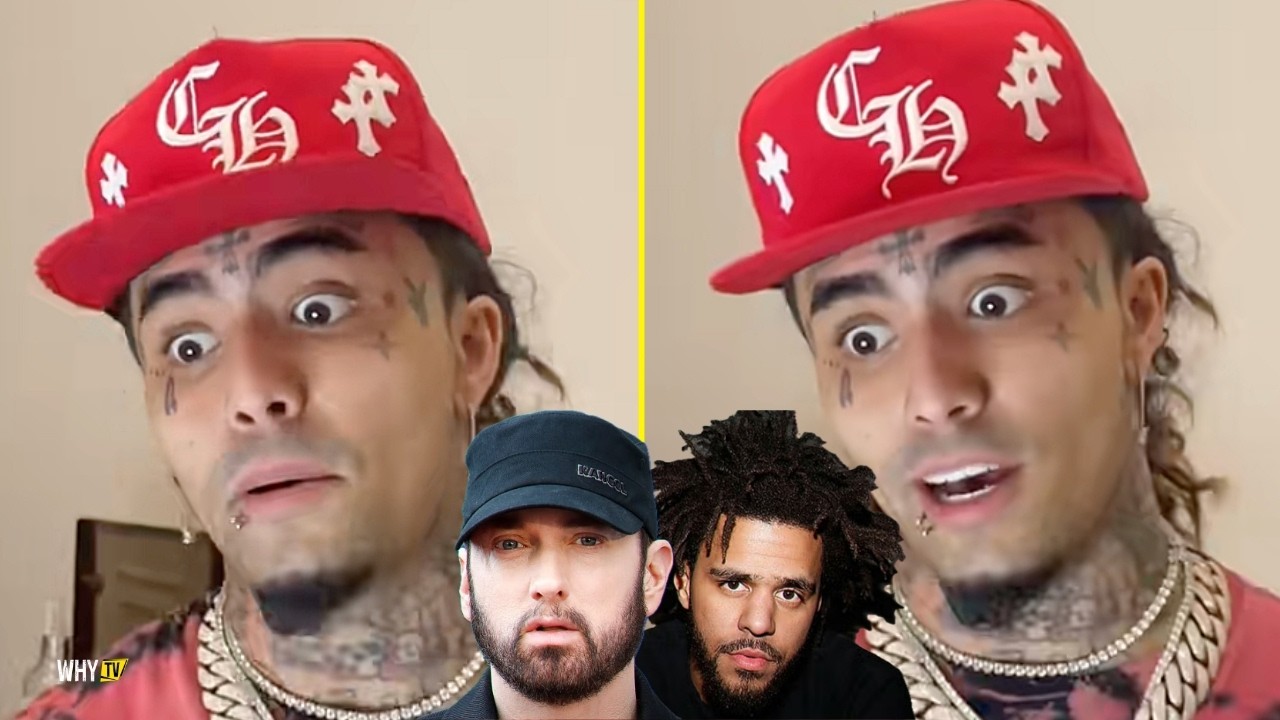 “Gucci Gang. 1. 2 billion views,” he boasted in the clip, pointing at the staggering figure.
“All right, I love it. 670 million views. Esketit, 700 million views.
Aesthetic has almost 600 million views. Boss has 334 million views.”
His statement was unapologetic and direct, drawing a hard line between his commercial success and the criticism he has absorbed from some of the genre’s most respected wordsmiths. For Pump, the explanation for those diss tracks is simple.
“Like, dude, understand rappers nowadays are numbers gang at all,” he said in the video. “I was hitting Taylor Swift numbers. That’s the reason why J.
Cole dissed me. That’s the reason why Eminem dissed me.”
It is a bold claim, but the data backs up part of his argument. His breakthrough single “Gucci Gang” has amassed more than 1.2 billion views on YouTube, placing him in an elite tier that few artists in any genre ever reach.
The history between Lil Pump and Eminem is well documented. In 2018, on the track “Fall” from his surprise album “Kamikaze,” Eminem took direct aim at the younger generation of rappers, calling out Lil Pump by name.
Eminem’s attack was surgical. He went after the perceived lack of substance in the new wave, dismissing the mumble rap movement and questioning the artistic merit of artists who dominated the charts with repetitive hooks and minimalist lyrics.
Lil Pump fired back instantly at the time, posting videos on Instagram mocking Eminem’s age and his album sales. The exchange became one of the most talked-about moments of 2018, pitting two generations of hip-hop against each other.
J. Cole’s approach was different but equally pointed. On “1985” from his album “KOD,” Cole did not mention Pump by name but dedicated an entire track to speaking directly to the young SoundCloud generation.
 Cole’s message was more measured, a cautionary tale rather than a straight-up diss. He warned young rappers about the fleeting nature of fame and the importance of financial literacy and longevity while acknowledging their cultural impact.
Now, years later, Lil Pump is retroactively claiming he knows exactly what motivated those lyrical attacks. In his view, the numbers speak for themselves, and his explosive streaming success made him a target.
His contention that he was hitting Taylor Swift numbers is not entirely hyperbolic. During his peak, Lil Pump was genuinely competing with the biggest pop stars on the planet in terms of video consumption and streaming figures.
“Gucci Gang” became a cultural phenomenon that transcended hip-hop, reaching into suburban households, international markets, and 𝓿𝒾𝓇𝒶𝓁 internet spaces that most rappers could never penetrate. Its ubiquity was undeniable.
The rise of SoundCloud rap in the late 2010s fundamentally changed the economics of hip-hop. Artists like Lil Pump, whose songs prioritized vibe over verbosity, found massive audiences that traditional gatekeepers never anticipated.
Eminem has built his entire brand on technical skill, complex rhyme schemes, and storytelling. Watching a rapper with a fraction of his wordplay surpass him in streaming numbers was clearly a point of friction.
J. Cole has positioned himself as a thinking man’s rapper, focused on substance and social commentary. The commercial dominance of artists like Lil Pump represented everything Cole’s artistic ethos appeared to stand against.
The “1985” verse was widely praised for its mature approach. Cole essentially told young rappers to enjoy the moment but not to confuse temporary dominance with lasting relevance in a genre built on longevity.
Lil Pump’s recent video suggests he rejects that framing entirely. For him, the numbers are the proof of concept. He had a run, a spectacular one, and he wants the respect that comes with it.
“These rappers nowadays are numbers gang at all,” he repeated, arguing that the very metrics by which modern hip-hop measures success place him at the top of the mountain, above the legends who came before.
 His catalog is genuinely impressive by streaming standards. “Esketit” has earned 700 million views, “I Love It” with Kanye West sits around 670 million, and “Aesthetic” approaches 600 million.
Those are not accidental numbers. They represent millions of hours of listening, a global fanbase, and a cultural footprint that extended far beyond the narrow boundaries of traditional hip-hop audiences.
Even his lesser singles like “Butterfly Doors” and “Flex Like Ouu” have crossed the 100 million mark, while earlier tracks like “Nephew” have maintained substantial view counts over time.
The video he posted is essentially a receipts scroll, a visual documentation of his dominance that he believes settles the argument once and for all. The message is clear: check the numbers.
It is a provocative claim, one that reframes those diss tracks as responses to his success rather than critiques of his art. Pump flips the narrative, making himself the protagonist of the story.
Hip-hop has always measured success in numbers, but the metrics have completely changed. Album sales used to be the gold standard. Then came radio play, ringtone sales, streaming, and now video views.
In this landscape, Lil Pump’s argument carries weight. He beat the legends at their own game by playing a different game entirely. While Eminem and J.
Cole were selling albums to dedicated fans, Pump was racking up billions of plays.
The debate over mumble rap has largely faded as the genre has evolved, but the tension between commercial success and critical respect remains as sharp as ever. Pump is not the first to use numbers as a shield.
The response to his video has been mixed. Some fans celebrate his bravado and the cold, hard data of his success. Others point out that Eminem and J.
 Cole have their own massive numbers spanning decades.
But Pump seems unconcerned with counterpoints. His career has been built on a defiant, unbothered energy. He has always been himself, for better or worse, and he is not apologizing for it now.
The broader cultural significance of his claim speaks to a larger generational conflict in hip-hop, between the lyricists who built the genre’s reputation and the 𝓿𝒾𝓇𝒶𝓁 stars who redefined its reach.
Lil Pump represents something that neither Eminem nor J. Cole could fully understand: the pure internet alchemy of a song becoming a meme, a catchphrase, a global movement, and a billion-view juggernaut.
“Gucci Gang” was not supposed to be a lyrical masterclass. It was a cultural event. And cultural events do not need complex verses to leave a mark on the consciousness of millions of listeners.
Whether his video changes anyone’s mind about the ongoing debate is unlikely, but it certainly reopens the conversation at a moment when hip-hop is once again reckoning with the role of numbers versus substance.
His catalog speaks for itself in the language of the streaming era. And right now, in that language, Lil Pump is fluent in a way that few artists, living or dead, can match.
The question remaining is whether Eminem and J. Cole will respond to Pump’s latest provocation. Both artists have been quiet recently, but history suggests that silence may not last.
If they do respond, Lil Pump is ready. He has the receipts. And in hip-hop, especially in the streaming age, receipts are the only currency that truly matters.