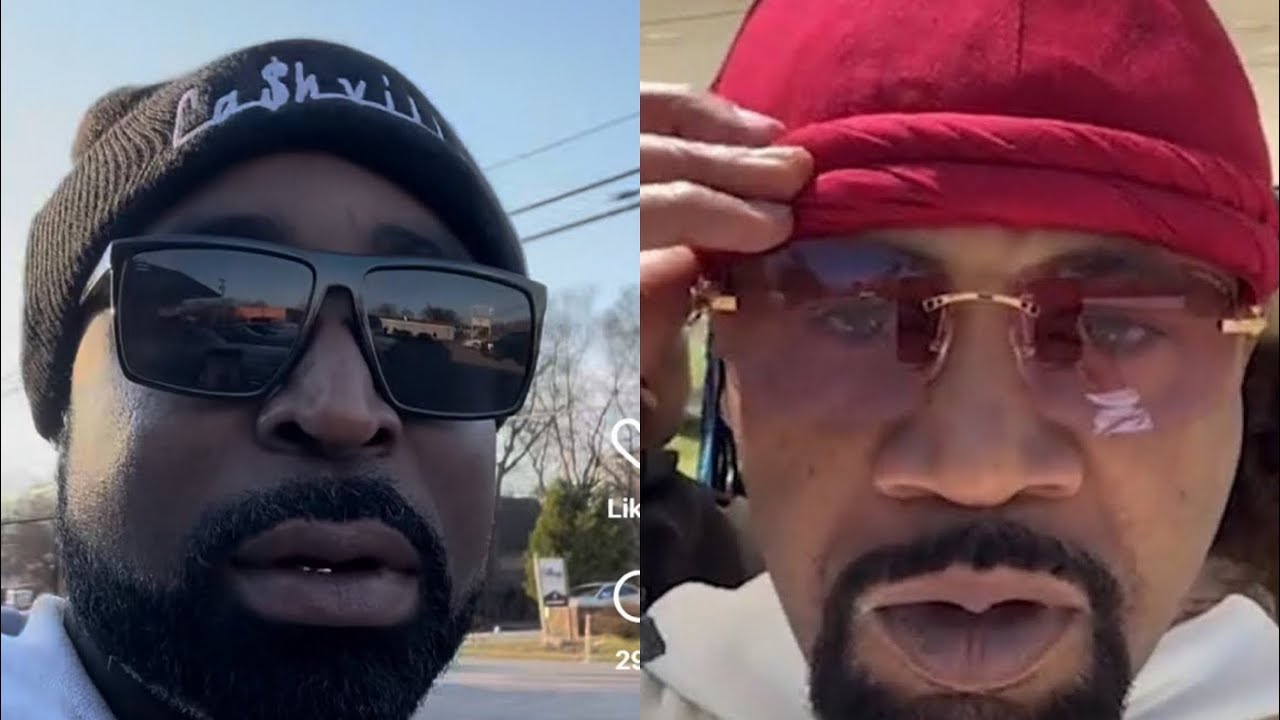
The simmering feud between hip-hop titans 50 Cent and Rick Ross has erupted into a full-scale war, drawing the legacies of Tupac Shakur and Eminem into the crossfire. What began as a standard exchange of barbs over album sales has spiraled into a deeply personal attack after Ross questioned 50 Cent’s upcoming musical collaboration featuring the late Tupac and his longtime ally, Eminem.
The conflict ignited when 50 Cent, born Curtis Jackson, revealed a surprise project that will utilize unreleased Tupac vocals, obtained with the blessing of the late rapper’s estate. In a recent interview, 50 Cent described the track as a theme for a new “Street Fighter” film, stating he worked alongside Eminem to finalize the record. The announcement was met with immediate skepticism and outrage from Rick Ross, who seized the opportunity to launch a blistering verbal assault.
 Ross did not simply critique the artistic choice of using posthumous music. He weaponized the announcement to question 50 Cent’s loyalty, targeting his relationship with Eminem while simultaneously accusing him of betraying a black female creator. In a now-𝓿𝒾𝓇𝒶𝓁 video, Ross mocked the project, stating, “Pop been dead 30 years.
Let the man rest in peace.” He then pivoted to 50 Cent’s departure from the hit television series Power, alleging Jackson blamed the show’s creator, Courtney Kemp, for its behind-the-scenes friction.
“Be loyal to the black woman the way you are to Eminem,” Ross taunted, directly comparing Jackson’s long-standing professional bond with the Detroit rapper to his alleged treatment of Kemp. Ross framed the situation as a racial and gendered slight, implying 50 Cent shields one collaborator while scapegoating another. This attack is calculated, targeting the bedrock of 50 Cent’s career, a relationship that dates back to when Eminem and Dr.
Dre signed him to Shady/Aftermath in 2003.
Ross’s strategy appears designed to expose a perceived hypocrisy. He argued that 50 Cent fails to grant Kemp the same public defense he offers Eminem, despite her role in building the multi-million dollar Power franchise. In his response, 50 Cent has not directly engaged the loyalty narrative.
Instead, he has deployed his signature trolling style, pivoting to attack Ross’s business ventures, including his sneaker line, which Jackson predicted would end up “in Costco,” and his sprawling estate.
 The feud has now transcended the music industry, turning into a public referendum on wealth, image, and authenticity. Jackson amplified the conflict by mocking Ross’s mansion, insinuating the property is used as an Airbnb to generate cash flow, a direct hit at Ross’s carefully curated image of untouchable wealth. “I only make deals that make sense,” 50 Cent posted, a line that seems to apply equally to his business acumen and his willingness to engage in this escalating war of words.
The central question posed by Ross, however, continues to resonate beyond the personal insults. The use of Tupac Shakur’s unreleased material over thirty years after his death has split the hip-hop community. While the estate’s approval offers legal clearance, critics argue that it represents a commodification of the artist’s legacy, forcing a voice from the grave into modern feuds and corporate projects that he never consented to.
Ross’s intervention forces a larger dialogue on the ethics of posthumous releases.
But the most dangerous shot fired by Ross may be the implication that 50 Cent is disloyal to the African American community. By contrasting his relationship with Courtney Kemp against his bond with Eminem, Ross is attempting to fracture Jackson’s street credibility and his reputation as a kingmaker. 50 Cent’s silence on the specific loyalty accusation is telling; his response has been purely focused on undermining Ross’s financial status, a classic deflection that avoids the deeper, more personal charge.
The landscape of this beef is crowded with collateral damage. Eminem, notoriously private and recently focused on his own legacy, is now a pawn in a battle he did not start. Tupac’s estate, meanwhile, faces renewed scrutiny over their approval of the usage of his vocals.
 For 50 Cent, the risk is that he comes across as a hypocrite, attacking Ross for a perceived lack of genuine street ties while himself partnering with corporate entities and leveraging the deceased for profit.
For Ross, the gamble is that his moral high ground will stick. If he can successfully paint 50 Cent as someone who uses black creators and then discards them while clinging to a white superstar, he wins a significant psychological victory. Currently, 50 Cent appears content to fight on the turf of materialism, joking about Ross’s rental property aesthetic and declining album numbers, a strategy that has worked for him for over a decade.
The public scorecard is fractured. Fans are divided, with some praising Ross for raising uncomfortable questions about ownership, credit, and racial dynamics in the industry, while others dismiss his critique as envy from a rapper who cannot match 50 Cent’s cross-platform success. Jackson’s response on social media has been a masterclass in chaos, ensuring that no single narrative dominates for long.
He has tagged Ross in memes, mocked his business partnerships, and questioned the authenticity of his luxury lifestyle.
This is not a simple rap beef over who has the better verse. It is a proxy war for control of the narrative in a changing industry. 50 Cent represents the mogul who bridges street culture and corporate power, while Ross positions himself as the old guard, the boss who built an empire the analog way.
 The entry of Tupac and Eminem into the fray elevates this from a petty squabble to a discussion about heritage, loyalty, and the price of success.
Industry insiders are watching closely. The outcome will not be decided by a diss track, but by the court of public opinion. 50 Cent’s ability to pivot from a serious accusation of disloyalty to a joke about a mansion is his greatest weapon.
Ross’s ability to stay on message, targeting the heart of Jackson’s character, is his. As of this report, the battle is in a state of volatile equilibrium, with each side preparing for the next move.
The question of who “won” the day remains irrelevant. The more critical issue is whether 50 Cent can survive the scrutiny of his business and personal relationships without losing his untouchable aura. Ross has placed a spotlight on a potential crack in the armor, and the resulting glare is illuminating more than just the music.
It is revealing the complex calculus of power, race, and money at the highest levels of the game.