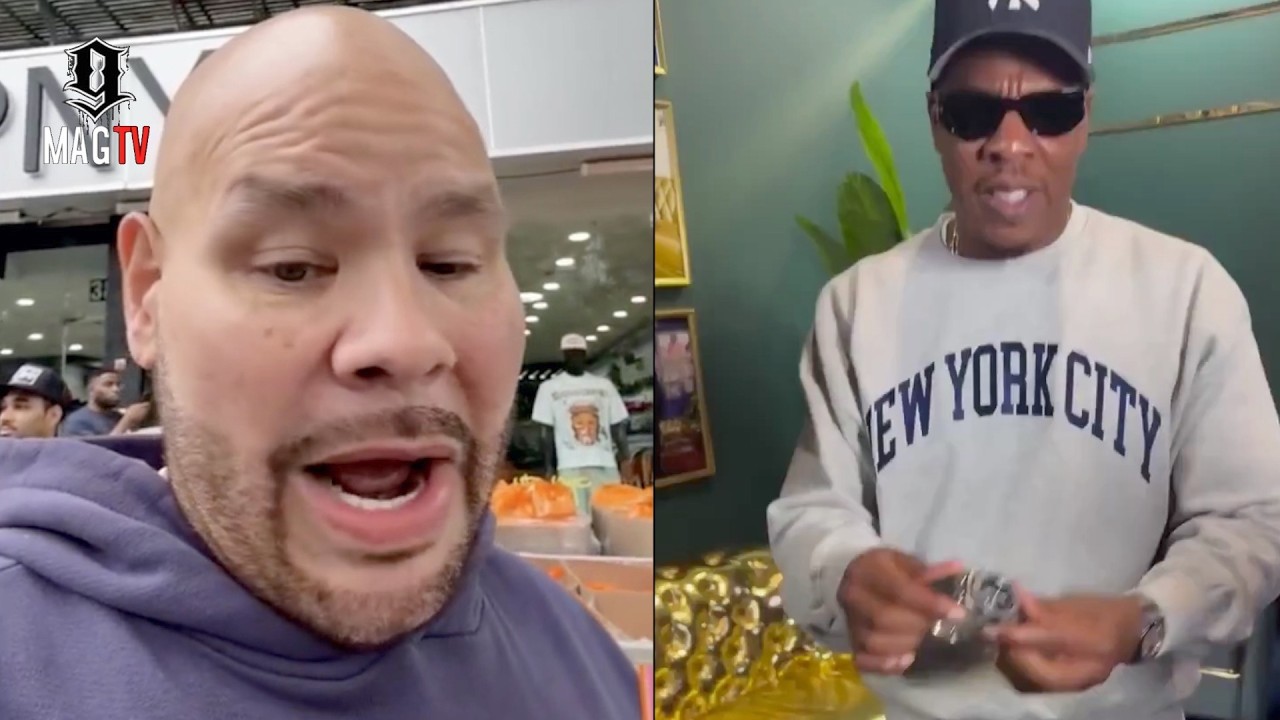
Radio host and media personality Ebro Rosenberg has ignited a firestorm of debate after delivering a scathing critique of Ja Rule and 50 Cent’s decision to perform together at a mega club event hosted by Donald Trump Jr. In an expletive-laced monologue captured on video, Rosenberg did not mince words, calling the collaboration “wack” and “trash.” The performance, which took place at Trump Jr.’s private club in New York, has drawn sharp criticism from fans and industry insiders alike, with Rosenberg leading the charge against two of hip-hop’s most iconic figures.

“I don’t like it. Let’s just start there. I think it’s wack,” Rosenberg said, his voice rising with apparent frustration. He specifically targeted Ja Rule, calling him a “buster,” and extended his disdain to 50 Cent and producer Timbaland, branding their involvement as “trash.” The video, which has since gone 𝓿𝒾𝓇𝒶𝓁, captures a raw, unfiltered reaction that has resonated with many who view the performance as a troubling alignment with the Trump political family.
Donald Trump Jr.’s club, known for its exclusive membership and high-profile events, has become a frequent venue for conservative-leaning gatherings. The decision by 50 Cent and Ja Rule to perform there has reignited longstanding questions about artists’ political affiliations and the intersection of entertainment and ideology. Rosenberg’s comments strike at the heart of this tension, accusing the performers of prioritizing business relationships over principle.
“The reason y’all are doing this is because you want the business relationships and you see these business opportunities for yourself,” Rosenberg asserted in the video. He dismissed the notion that the performance was merely about earning a paycheck, noting that neither 50 Cent nor Ja Rule needs money. “You got a private … $500 membership for the club. We don’t know what they’re getting paid,” he added, suggesting the motivation runs deeper than cash.
The criticism comes amid a broader cultural reckoning within hip-hop regarding political engagement. 50 Cent, whose real name is Curtis Jackson, has long flirted with political commentary but has never officially endorsed a candidate. Rosenberg pointedly questioned the rapper’s voting history, saying, “First of all, I don’t even know if 50’s ever voted. So, as much as he’s chimed in on politics, do we know if he’s actually ever cast a vote? No, he’s never endorsed anyone.”
Ja Rule, meanwhile, has faced similar scrutiny for past ventures that blurred lines between entertainment and politics. The duo’s decision to perform at an event tied to Donald Trump Jr. has been met with particular backlash given Trump Jr.’s role as a prominent surrogate for his father, former President Donald Trump. The performance took place at the “Mega Club Event,” a name that underscores the glitzy, high-stakes nature of the gathering.

Rosenberg’s reaction is not an isolated one. Social media has been flooded with responses ranging from disappointment to outright condemnation. Many fans have expressed confusion over why two artists who once feuded publicly—50 Cent and Ja Rule famously had a bitter rivalry in the early 2000s—would unite on a stage that some view as politically charged. The performance, rather than being a celebration of rap unity, has become a lightning rod for controversy.
Industry observers note that the event represents a new frontier in the ongoing debate over artists and politics. Unlike the 2016 election, when musicians openly aligned themselves with candidates, the current climate sees more subtle—and often more lucrative—forms of political engagement. Private performances for wealthy donors and club members have become a growing revenue stream, but they also carry risks of alienating core fan bases.
Ebro Rosenberg, a veteran of New York’s Hot 97 and now co-host of “Ebro in the Morning” on Apple Music, has never shied away from controversial takes. His reaction to the Ja Rule and 50 Cent performance is consistent with his track record of calling out hypocrisy in the music industry. In the video, he directly addressed the performers, saying, “And these other — how about I think he’s wack for all of y’all. Ja Rule, buster, 50, Timbaland, I think it’s trash.”
The video transcript also captures Rosenberg wrestling with the notion that the performance might simply be about earning a bag, but he ultimately rejects that explanation. “I don’t think it’s just grab a bag,” he said, before briefly reconsidering: “But yeah, okay, maybe it is just a bag. But it all … a lot of these dudes, even when you see … Ivanka Trump and Hov and Bey and they were sitting at the fundraiser table, right? Like it’s all just big money.”
Rosenberg’s reference to Jay-Z and Beyoncé sitting at a fundraiser table with Ivanka Trump highlights the complex web of relationships between A-list entertainers and political families. The Beyoncé-Jay-Z example underscores that even artists who have voiced progressive views may engage in transactional interactions across the aisle. Yet the distinction, Rosenberg implies, lies in the context and the consistency of one’s political stance.

The performance by 50 Cent and Ja Rule also invites comparison to other artists who have performed for controversial figures. In recent years, musicians ranging from Kid Rock to Kanye West have faced backlash for aligning themselves with Trumpian circles. But the involvement of 50 Cent and Ja Rule—both of whom have built careers on street credibility and authenticity—has struck a particularly discordant note.
Neither 50 Cent nor Ja Rule has publicly responded to Rosenberg’s criticism as of this writing. However, representatives for both artists have been contacted for comment. The silence may be strategic, as any response could amplify the controversy further. Meanwhile, Donald Trump Jr. has not commented on the backlash, but sources close to the event describe it as a success, with attendees reportedly thrilled by the surprise performance.
The venue, described in promotional materials as a “mega club,” operates on a membership model with annual fees reported to be $500 or more. The exclusivity of the setting adds another layer to the criticism, as it pits populist sentiments against elite gatherings. For many hip-hop fans, the idea of two legendary rappers performing for a wealthy, politically homogeneous audience feels like a betrayal of the genre’s roots in activism and protest.
Rosenberg’s video ends on a somewhat ambiguous note, with him saying, “Yo, what up? It’s Mr. X to the Z, Exhibit A 2 B. Let’s keep it going.” This coda suggests a continuation of the conversation, perhaps on his radio show or in future broadcasts. It also implies that the controversy is far from over. As the video continues to circulate, it is likely to fuel further debate about the role of artists in a polarized political landscape.
From a broader perspective, the incident reflects a growing trend where musicians are forced to navigate increasingly treacherous political waters. The line between entertainment and advocacy has blurred, and performances that were once seen as apolitical are now scrutinized for their political implications. Ebro Rosenberg’s reaction may be just the beginning of a wider reckoning for artists who choose to align themselves with controversial figures, regardless of the paycheck involved.

The news of this reaction comes at a time when the music industry is already grappling with questions of accountability and alignment. The #MeToo movement, Black Lives Matter, and other social justice campaigns have prompted many artists to speak out on issues. Yet the decision to perform at an event hosted by Donald Trump Jr. suggests that some still prioritize career advancement over political consistency. Rosenberg’s blunt assessment cuts to the core of this hypocrisy.
As of now, the long-term impact on 50 Cent and Ja Rule’s careers remains to be seen. Both artists have weathered far more serious controversies in the past, but the current political climate is unforgiving. Fans who once embraced 50 Cent’s anti-authoritarian persona may now view him as just another celebrity chasing lucrative gigs. Ja Rule, who has reinvented himself as a entrepreneur and festival organizer, may also face reputational damage.
Ebro Rosenberg’s commentary has already sparked a wave of online discourse, with hashtags related to the performance trending on X (formerly Twitter). Some users have defended the artists, arguing that music should transcend politics. Others have echoed Rosenberg’s sentiment, calling the performance a disgrace to hip-hop. The division highlights the deep polarization that now characterizes even the most seemingly straightforward entertainment decisions.
In the coming days, more details are expected to emerge about the event, including the financial arrangements and the artists’ motivations. Industry analysts note that private performances for wealthy patrons are a standard practice, but the public nature of this particular event—coupled with the high profile of the host—has made it newsworthy. Rosenberg’s video ensures that the conversation will continue, placing pressure on 50 Cent and Ja Rule to address the criticism directly.
For now, the breaking news remains Ebro Rosenberg’s explosive reaction, which has captured the attention of hip-hop fans and political observers alike. His words serve as a litmus test for how the music community is navigating the treacherous terrain of political engagement in the Trump era. As the story develops, this moment may be remembered as a turning point in how artists’ choices are judged by the public and the press.