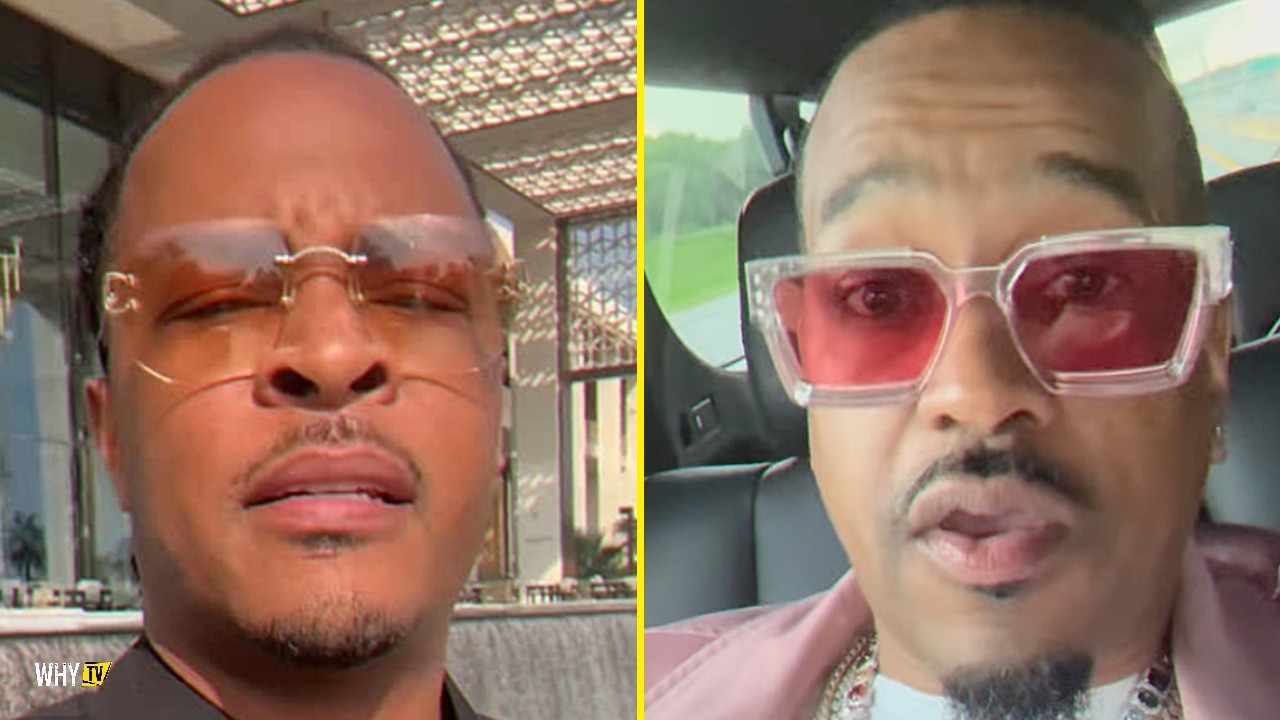
The simmering feud between Atlanta rap icon T.I. and music executive Ray Daniels has erupted into a full-blown public confrontation, with the Grammy-winning artist delivering a blistering ultimatum during a high-stakes radio appearance. In an explosive segment on The Breakfast Club, T.I. did not mince words, directly addressing Daniels’ repeated criticisms and issuing a stark warning for the executive to stay out of Atlanta’s affairs. The rapper, whose real name is Clifford Harris, labeled Daniels an “implant” and a “visitor” in the city’s music scene, challenging his authority to speak on local industry matters.
 The tension stems from a series of remarks made by Daniels on The God’s Show, where he doubled down on his previous assessment that T.I. has been “chasing hits” and trends rather than maintaining his artistic integrity. Daniels, who has worked with numerous high-profile acts, stood by his comments, insisting they were honest observations about the rapper’s career trajectory. However, T.I.’s response was swift and unyielding, shifting the focus from artistic critique to territorial loyalty and authenticity within Atlanta’s hip-hop ecosystem.
During the Breakfast Club interview, T.I. made it clear that Daniels’ status in Atlanta is not that of a native son but of an outsider who has overstayed his welcome. “I told Ray Daniels stay out of Atlanta business, man,” T.I. declared, his voice carrying a mix of frustration and authority. “He’s an implant. He was welcomed, and he shouldn’t take that welcoming as a sign that he is a fixture. He’s still a visitor.” The rapper’s words were a direct challenge to Daniels’ credibility, implying that without deep roots in the city, his opinions carry less weight.
The exchange has ignited a firestorm of debate online, with fans and industry insiders taking sides. Some argue that Daniels, as a veteran executive, has every right to critique an artist’s work, regardless of geography. Others side with T.I., claiming that Daniels’ outsider status undermines his ability to understand the cultural and economic pressures facing Atlanta’s homegrown talent. The controversy has also raised questions about who gets to define authenticity in hip-hop, a genre built on regional pride and personal narrative.
 T.I. further elaborated on his stance, emphasizing the importance of respecting the city’s native artists who have built its legacy from the ground up. “When it’s real homegrown products of this community, these communities of this city, and we dealing with things, man,” he said, trailing off as if to underscore the weight of the responsibility. The rapper’s comments suggest that Daniels’ critiques are not just about music but about a perceived lack of understanding of the struggles and triumphs that define Atlanta’s hip-hop identity.
The feud has also drawn attention to Daniels’ own background, with many online questioning his origins. During the interview, the Breakfast Club hosts expressed confusion, with one noting, “I thought he was from Atlanta.” T.I. quickly corrected them: “Hell no. He from New York? I don’t know. I don’t know where he from.” This uncertainty has fueled the narrative that Daniels is an interloper, a figure who has benefited from Atlanta’s hospitality without fully earning his place in its cultural hierarchy.
Ray Daniels has not yet responded to T.I.’s latest broadside, but his earlier statements suggest he is unlikely to back down. On The God’s Show, he maintained that his critiques were rooted in a desire to see artists evolve, not to tear them down. “I’m just giving my honest opinion,” Daniels said, defending his right to speak candidly. However, T.I.’s reaction indicates that the line between professional critique and personal disrespect has been crossed, at least in the rapper’s eyes.

The implications of this feud extend beyond personal animosity. Atlanta remains one of the most influential hubs in hip-hop, and disputes over who has the right to shape its narrative are not new. T.I.’s defense of his city’s “homegrown products” resonates with a broader sentiment that local artists should have priority in defining the culture. By calling out Daniels as an “implant,” T.I. is drawing a line in the sand, asserting that outsiders must tread carefully when commenting on Atlanta’s music scene.
Social media has been ablaze with reactions, with hashtags like #TeamTI and #RayDaniels trending in some circles. Fans have dissected every line of the Breakfast Club interview, with many praising T.I. for standing up for his city. “T.I. is absolutely right. Ray Daniels doesn’t get to come in and dictate what Atlanta should sound like,” one user wrote. Others have defended Daniels, arguing that his experience in the industry gives him a valid perspective. “Criticism isn’t disrespect. Ray has worked with legends. He knows what he’s talking about,” another countered.
 The timing of this feud is particularly charged, as Atlanta’s music scene continues to evolve amid shifting industry dynamics. T.I., who has been a staple of the city’s hip-hop landscape for over two decades, represents a generation of artists who built the foundation for today’s stars. Daniels, meanwhile, has been a behind-the-scenes force, helping to shape careers but often operating outside the spotlight. Their clash highlights the tension between legacy and influence, between those who create and those who critique.
As the story develops, all eyes are on whether Daniels will issue a response or let the controversy simmer. T.I.’s call for him to “stay out of Atlanta business” is a clear demand for deference, but it remains to be seen if the executive will comply. For now, the rap community is left to debate the boundaries of criticism, the meaning of authenticity, and the power of regional loyalty in an industry that often blurs those lines.
The Breakfast Club interview has become a flashpoint, with T.I.’s words echoing across platforms. His refusal to accept Daniels’ commentary as legitimate has struck a chord with those who feel that Atlanta’s story should be told by its own. “Ain’t it cool for everybody to have their opinion? Ain’t no problem with that,” T.I. said, before adding the crucial caveat: “He not from Atlanta.” That distinction, in his view, changes everything.
In the coming days, the fallout from this exchange is likely to intensify, with fans, artists, and executives all weighing in. T.I. has made his position clear, and Ray Daniels now faces a choice: engage further or step back. Either way, this moment has already cemented itself as a defining chapter in the ongoing conversation about who owns the narrative in hip-hop’s most vibrant city. The battle lines are drawn, and Atlanta’s music scene is watching closely.