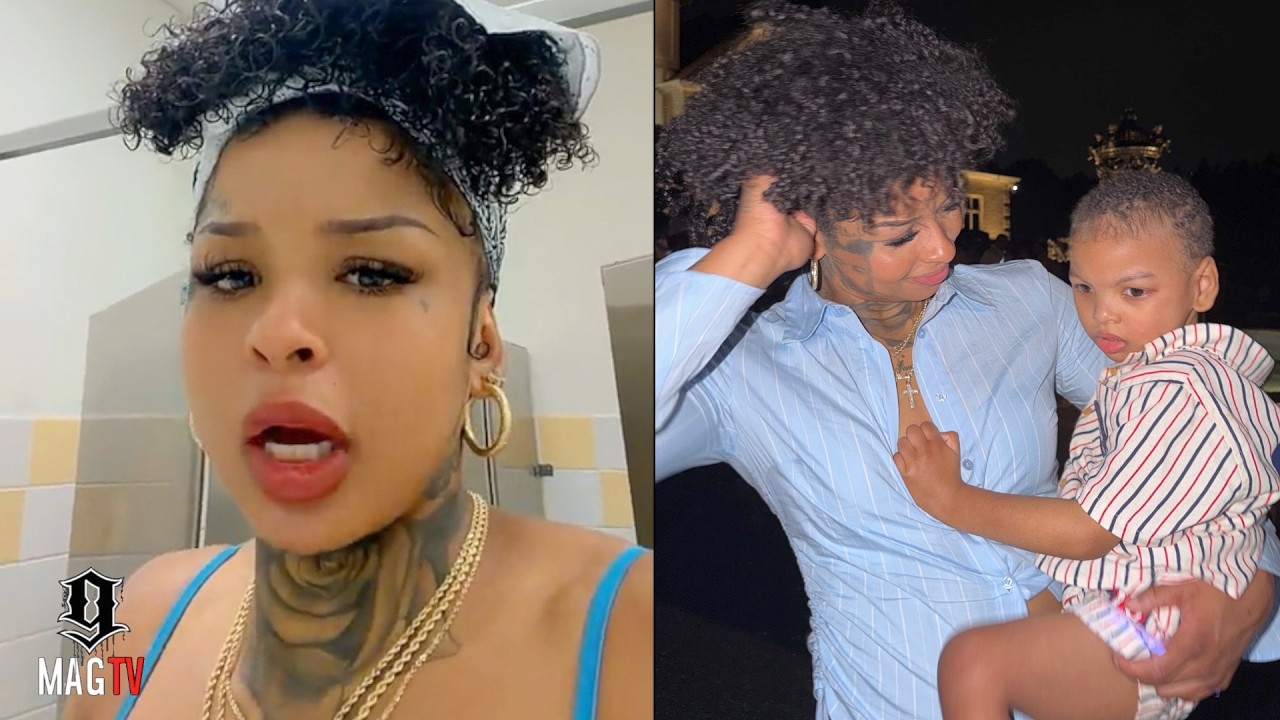
The ongoing public feud between the family of rapper Blueface and his former girlfriend has escalated to a dramatic and deeply personal level, with the rapper’s mother, Karlissa Saffold, unleashing a torrent of accusations and warnings directly at Nevaeh. In a lengthy and emotionally charged video, Saffold, known widely as Karlissa, did not hold back, issuing what she framed as a final “goodbye” to the young mother following Nevaeh’s public announcement that she was ending her relationship with Blueface. The video, which has rapidly circulated across social media platforms, marks a significant and explosive chapter in the family’s very public 𝒹𝓇𝒶𝓂𝒶, moving beyond typical relationship disputes into accusations of manipulation, disrespect, and even spiritual warfare.
Saffold’s primary grievance, which she returned to repeatedly throughout the nearly hour-long diatribe, centered on a photograph of her granddaughter, Journey, which she claims Nevaeh displayed in a bathroom of the home she shared with Blueface. To Saffold, this act was not an innocent decoration choice but a calculated and malicious move designed to mock her and the child’s mother, Jaidyn Alexis. She interpreted the placement of the child’s picture in such an intimate and private space as a deliberate provocation, questioning Nevaeh’s motives and accusing her of trying to send a “subliminal” and “wicked” message.
 The outrage over this specific detail served as the catalyst for a broader condemnation of Nevaeh’s character, parenting, and moral compass, as Saffold declared that the relationship was irrevocably damaged.
The emotional intensity of Saffold’s message was palpable as she transitioned from expressing initial hesitancy about judging Nevaeh to a full-throated declaration of her unworthiness. She admitted that she had been on the verge of giving Nevaeh a chance, of perhaps attributing her past actions to a lack of guidance or understanding. However, the photograph of Journey, she insisted, was a line that should never have been crossed.
“You played with God in his face,” Saffold declared, framing the act not just as a personal insult but as a spiritual transgression that would have consequences. She invoked the image of praying mothers who had covered the child in protective prayers, suggesting that Nevaeh’s actions had placed her on the wrong side of a divine power she did not fully comprehend.
Central to Saffold’s fury was a stark comparison between how Nevaeh treated the child of her partner versus how she treated her own children. Saffold pointedly noted the absence of any photographs of Nevaeh’s own two sons within the home, a detail she found deeply telling and damning. She questioned how a mother could display a picture of her boyfriend’s daughter in the bathroom while failing to have pictures of her own children on the walls or in frames.
This observation led Saffold to launch into a scathing critique of Nevaeh’s parenting skills, accusing her of a lack of love for her own children and even referencing a past incident involving an alleged backhand to one of the children, a claim that adds another layer of gravity to the accusations being leveled.
The conflict took an even more surreal turn when Saffold introduced the subject of a tattoo on Nevaeh’s leg, which she claimed depicted the rapper NBA YoungBoy. According to Saffold, this tattoo was a hidden secret that had just been 𝓮𝔁𝓹𝓸𝓼𝓮𝓭, and she framed its revelation as a direct act of divine intervention in response to Nevaeh’s actions with Journey’s picture. “God working in 4K,” she proclaimed, suggesting that the universe was aligning to reveal Nevaeh’s true nature and hidden deceptions to Blueface.
Saffold used this as further proof that Nevaeh was not to be trusted, alleging that she had lied to her son and that this exposure would forever alter his perception of her. The narrative wove together personal grievance with a sense of cosmic justice, painting Nevaeh as a figure whose schemes were unraveling in real-time.
Saffold’s threats extended beyond mere words, as she explicitly warned Nevaeh about the legal and personal consequences of her actions. She dared Nevaeh to file for child support, countering that she and her son would instead file for full custody of the children. “I’mma raise my grandson,” she declared, promising a legal battle should Nevaeh attempt to use the system against them.
This threat was accompanied by accusations of fraud and a general condemnation of Nevaeh’s lifestyle, with Saffold painting a picture of a woman who was unfit to care for her own children. The message was clear: if Nevaeh wanted to play games, she was prepared to engage in a fight that would have lasting repercussions on her family structure.
The video also served as a platform for Saffold to demand an apology, not just to herself or Blueface, but to Jaidyn Alexis, the mother of Journey. She insisted that Nevaeh owed Jaidyn a direct apology for involving her child in the adult conflict. This demand highlights the complex web of relationships involved, where the children are caught in the crossfire of a dispute between their parents and their parents’ new partners.
Saffold positioned herself as the protector of her grandchildren, vowing to shield them from what she perceives as the toxic and harmful influence of Nevaeh. Her language was that of a guardian preparing for war, determined to ensure the safety and well-being of her family at any cost.
 Throughout the video, Saffold repeatedly invoked religious imagery and language, casting the conflict as a battle between good and evil. She referred to the “blood of Jesus” covering her granddaughter and warned Nevaeh that “vengeance belongs to the Lord.” This framing elevated the personal dispute to a spiritual level, suggesting that Nevaeh had not only wronged a family but had also aligned herself with demonic forces.
Saffold’s rhetoric was designed to rally support from her audience, many of whom she thanked for their prayers, while simultaneously demonizing Nevaeh in the most absolute terms possible. It was a performance of righteous indignation, with Saffold casting herself as the voice of moral authority in a situation she believes has spiraled into depravity.
The specific accusation regarding the bathroom photograph was dissected by Saffold with a mixture of disgust and bewilderment. She questioned the logic and intent behind placing a child’s picture in a location associated with intimacy and personal hygiene. “Why would I put a picture of my husband’s kids in our bathroom where we on the counter sometimes?”
she asked rhetorically, implying that the placement was a deliberate attempt to create a disturbing and inappropriate dynamic. She contrasted this with the proper way to display children’s photos, which she argued should be in frames and in common areas of the home, not in the bathroom. This focus on the physical placement of the photo served as a tangible symbol of what Saffold views as Nevaeh’s fundamentally flawed and malicious character.
Saffold also traced Nevaeh’s behavior back to her own mother, claiming that such “demonic” actions were learned behavior. She referenced a past incident where Nevaeh’s mother allegedly went into another room and deliberately placed a picture, suggesting a pattern of manipulative behavior that ran in the family. This attempt to indict the entire family further widened the scope of the conflict, turning it into a generational feud.
By attacking Nevaeh’s upbringing and her mother’s influence, Saffold was not just criticizing her son’s ex-girlfriend but was questioning the very foundation of her character and values. It was a comprehensive assault designed to delegitimize Nevaeh in every possible way.
The video concluded with Saffold issuing a final, ominous warning, telling Nevaeh that she had “played herself” and would now face the consequences of her actions as a single mother. She predicted a future of hardship for Nevaeh, contrasting it with the protection and love she promised to provide for her grandchildren. “You can sit there and watch us raise your baby since you want to be a smart now,” she taunted, cementing her intention to remain a formidable presence in the lives of her grandchildren.
The message was a declaration of war, a final word that left little room for reconciliation or understanding. As the video ends, the future of this fractured family remains uncertain, but it is clear that Karlissa Saffold has no intention of backing down from what she sees as a righteous fight for her family’s honor and safety.
The public nature of this breakdown is consistent with the family’s history of airing their private conflicts on social media, but the intensity and specific nature of these accusations mark a new level of escalation. The reference to a tattoo of another rapper, the detailed description of the photograph’s placement, and the threats of legal action for custody all point to a situation that has moved far beyond simple bickering. Saffold’s monologue was a performance of grievance, a public shaming designed to rally her followers to her side and to apply maximum social pressure on Nevaeh.
It remains to be seen how Nevaeh will respond, but the gauntlet has been thrown down in the most dramatic fashion possible.
 This incident also raises uncomfortable questions about the well-being of the children involved, who are being discussed in such a public and vitriolic manner. Saffold’s threats to seek custody, her descriptions of Nevaeh’s parenting, and her invocation of past incidents of alleged violence all paint a picture of a chaotic and unstable environment. While Saffold positions herself as the protector, her method of airing these grievances on a public platform, with millions of potential viewers, is itself a form of exposure that can be harmful to the children she claims to want to shield.
The line between advocacy and exploitation becomes blurred when family disputes are turned into content for public consumption.
The reaction from the online community has been predictably divided, with some supporting Saffold’s right to defend her family and others criticizing her for the public and aggressive nature of her attack. Many commenters have expressed concern for the children, urging the adults to resolve their issues privately. Others have taken sides, using the video as further evidence in their own judgments of the individuals involved.
The incident has become a trending topic, drawing in audiences who are fascinated by the 𝒹𝓇𝒶𝓂𝒶 and the larger-than-life personalities involved. The saga of Blueface and his family continues to be a source of endless entertainment and speculation for the public, even as it involves real people and real consequences.
For Blueface himself, who is currently incarcerated, this latest development adds another layer of complexity to his already complicated personal life. He is unable to publicly respond or intervene, leaving his mother to act as his surrogate and defender. Saffold’s video can be seen as an attempt to manage his affairs from the outside, to protect his interests and his children in his absence.
However, her aggressive tactics may also create more problems, potentially alienating the mother of his other children and further destabilizing the family dynamic. The long-term effects of this public feud on Blueface’s relationships with all of the mothers of his children remain to be seen.
The specific claim about the NBA YoungBoy tattoo is a particularly salacious detail that has captured the attention of many. Saffold presented it as a “skeleton in the closet” that was 𝓮𝔁𝓹𝓸𝓼𝓮𝓭 by divine intervention, a piece of evidence that proved Nevaeh’s duplicity. The implication is that Nevaeh was harboring feelings or connections to another rapper while being with Blueface, a betrayal that cuts to the core of the relationship.
Whether the tattoo is real or a rumor, Saffold’s decision to highlight it in her video demonstrates her willingness to use any and all information to destroy Nevaeh’s credibility. It is a tactic designed to humiliate and isolate, leaving Nevaeh with little room to defend herself.
Saffold’s repeated references to “playing with God” and the spiritual consequences of Nevaeh’s actions suggest a deeply held belief system that informs her worldview. She is not just angry; she believes that Nevaeh has committed a sin that will bring about its own punishment. This religious framing gives her a sense of moral certainty and purpose, making her attacks feel righteous rather than merely vindictive.
It also serves to rally a certain segment of her audience who share her religious convictions, creating a community of support around her crusade. The conflict is thus not just a family 𝒹𝓇𝒶𝓂𝒶 but a moral lesson being played out in public, with Saffold as the prophet warning of impending doom.
 The accusation that Nevaeh does not have pictures of her own children in the home is a powerful and emotional point that Saffold hammered home repeatedly. It is a visceral image that resonates with many parents, for whom displaying photos of their children is a natural and fundamental act of love. By claiming that Nevaeh’s home is devoid of such images, Saffold is making a profound statement about her priorities and her maternal instincts.
It is an attack on her very identity as a mother, suggesting that she is more focused on her relationship with a man than on her own flesh and blood. This line of attack is likely to be particularly damaging to Nevaeh’s public image.
The threat of a custody battle is perhaps the most serious and consequential aspect of Saffold’s video. It moves the conflict from the realm of social media 𝒹𝓇𝒶𝓂𝒶 into the potential arena of the legal system. Saffold’s declaration that she will help her son raise the child, and her dare for Nevaeh to file for child support, signals a willingness to engage in a protracted and expensive legal fight.
This is a significant escalation that could have lasting implications for the child’s upbringing and the relationship between the parents. It is a threat that cannot be easily dismissed, and it suggests that Saffold is prepared to take drastic steps to ensure her vision for her family is realized.
As the video continues to circulate and the online discourse intensifies, the focus remains on the volatile and public nature of this family’s conflicts. The saga of Blueface, his various partners, and his mother has become a recurring spectacle, with each new installment drawing more attention and more extreme reactions. This latest video, with its mix of personal attacks, spiritual warnings, and legal threats, is a prime example of how personal pain is being broadcast for public consumption.
The line between private family matters and public entertainment has long been crossed, and the individuals involved seem willing participants in their own 𝒹𝓇𝒶𝓂𝒶.
The impact on the children, particularly Journey, is a concern that hangs over the entire situation. Saffold’s passionate defense of her granddaughter is understandable, but the manner in which she is conducting that defense, by turning the child into a central figure in a public feud, is problematic. The child’s image and name are being invoked in a highly charged and negative context, which could have lasting psychological effects.
While Saffold claims to be protecting the child, her actions are also exposing her to a level of scrutiny and conflict that no child should have to endure. The adults in this situation seem to have lost sight of the children’s best interests in their quest to win a public battle.
In the world of celebrity gossip and social media feuds, this incident stands out for its raw emotion and its deeply personal nature. Karlissa Saffold has laid bare her feelings of betrayal and anger, sparing no detail in her condemnation of Nevaeh. Her video is a masterclass in public shaming, using every tool at her disposal to paint her target in the most negative light possible.
Whether her accusations are entirely accurate or colored by her own biases, the impact is undeniable. The relationship between Nevaeh and the Blueface family appears to be irreparably broken, and the fallout from this public explosion will likely be felt for a long time to come.
The final message from Saffold was one of dismissal and warning, a “goodbye” that was less a farewell and more a curse. She predicted a future of struggle for Nevaeh, a life of hardship that she believes is a direct result of her actions. This prophetic tone, combined with her threats of legal action and her detailed recounting of grievances, leaves little room for ambiguity about her feelings.
The door has been slammed shut, and Saffold has made it clear that she will do everything in her power to ensure that Nevaeh is no longer a part of her son’s life or the lives of her grandchildren. The stage is set for the next chapter in this ongoing saga, which is sure to be just as dramatic and public as the last.